


What Goes in a Fibre Trench, and Why It Decides the Next Twenty Years
Most of a fibre network’s value is buried. Under the footway and the verge, a run of duct carries the cable, a drawrope waits inside for the next pull, and a layer of tile tape sits above it all to warn the next person who digs. Get those three right and the route can be used, extended and upgraded for decades without opening the ground again. Get them wrong and every future change starts with an excavator.
Each of these products has its own specification, but they work as a system, and the choices made for one affect the others. This guide is written for the people planning and building underground fibre routes. It walks through the route from the bottom of the trench up: the duct, the drawrope that goes inside it, the cable pull, and the tile tape that protects it, with a checklist to take to site.
The underground route as a system
A buried fibre route has three layers that do three different jobs.
The duct is the pathway. It protects the cable from ground movement, moisture and damage, and it lets cables be pulled in, pulled out and replaced without digging. The drawrope is the access. It pulls the first cable through, and a fresh rope left in the duct afterwards means the next cable can go in without rodding. The tile tape is the warning and the shield. Laid above the duct in the backfill, it tells anyone excavating that there is a live service below, and gives a physical barrier between their tool and your cable.
Duct protects the cable, drawrope keeps the route usable, and tile tape protects the route from the next dig. Leave one out and the other two work harder.
Step one: choosing and laying the duct
The duct sets the capacity of the route for its whole life, so size it for the future, not just the first cable. Mountrel Ducts are solid-wall uPVC pipes with strong impact resistance, UV stability and a low-friction bore that makes cable pulling and blowing easier. They are available in a range of sizes, colours and bend angles, so a route can follow utility colour-coding and the alignment of the trench, and they connect with a full range of couplings, bends and accessories.
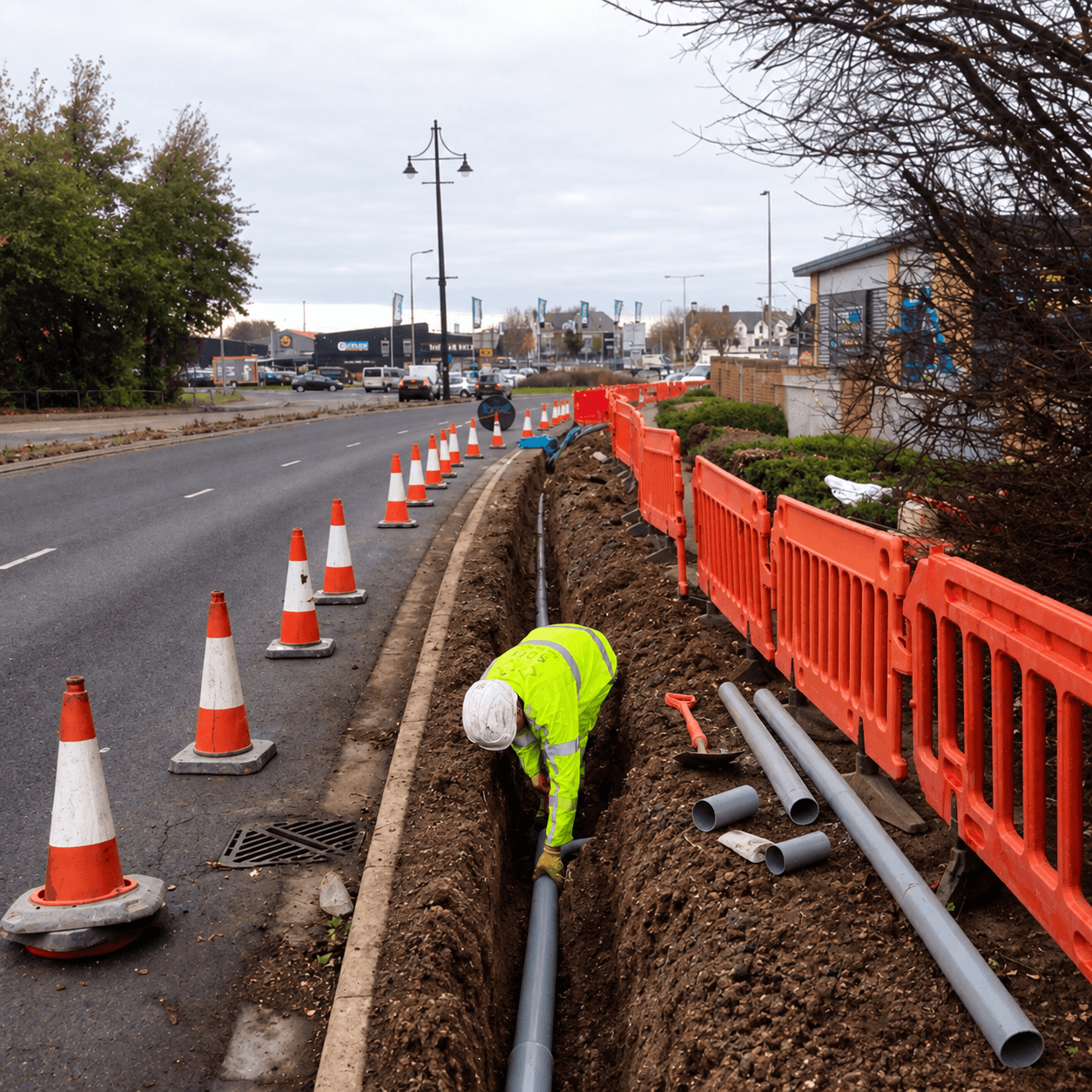
In the trench, lay duct on a smooth, stone-free bed, keep joints fully pushed home so soil and water stay out, and use long, gentle bends rather than tight ones, because every bend adds friction to every future pull. Seal duct ends until they are needed. Follow the street works depth and positioning guidance and the asset owner’s specification for the location. Our guide to specifying cable ducting covers duct selection in more detail.
Step two: drawrope in every duct
A duct with no rope in it is a duct that needs rodding before it can be used. That is why a drawrope should go into every duct as it is laid, including spare ways that will not carry cable straight away.
BlueForce Drawrope is built for this job. It is a 3-strand twisted rope, 6mm in diameter and supplied in 500m lengths on an 8kg reel, made from a polypropylene and polyethylene blend with a breaking load of 6.8kN. It has excellent chemical resistance and low water absorption, so it keeps its strength in a wet duct, and moderate UV resistance for handling on site. One 500m reel covers most duct runs without joins, and the high-visibility blue makes it easy to identify at the chamber.
For longer or heavier underground pulls where stretch becomes a problem, a low-stretch rope such as Rope Cabling No.4 keeps more of the pulling force on the cable. Our guide to specifying drawrope explains how to match rope strength and type to the pull.
Step three: pulling the cable
With duct laid and rope in place, the cable pull itself is about control. Before pulling, check the duct is clear and clean along its length. Set the cable drum on a stand such as the Universal Cable Drum Dispenser or the Cable Dispenser A-Frame, so it turns freely and feeds the cable without kinks or twists. Attach the rope to the cable with a suitable pulling grip, and pull steadily rather than in snatches, because peak tension at a bend is what breaks ropes and damages cable.
When the cable is through, pull a fresh length of drawrope in alongside it, or into the spare way, and tie it off at both ends. That leave-in rope costs very little and turns the next cable pull from a half-day of rodding into a ten-minute job.
Step four: tile tape above the duct
The final layer goes in during backfill. TapeTile, our underground cable protection tile, combines a printed warning film with a tough polyethylene base, supplied in rolls so it can be laid in a single pass along the trench. It gives high-visibility warning text to anyone excavating, and a physical layer of protection between their tool and the duct below.
TapeTile is manufactured to comply with the Energy Networks Association specification ENA TS 12-23 (Class 1 and Class 2) and is approved by UK DNOs, and it is suitable for fibre and telecoms routes as well as power, gas and water. It is rot resistant and chemically inert, so it lasts in demanding soil, and it is light enough to install quickly in any weather. Custom text is available subject to minimum order quantity. Lay it centrally above the duct, at the depth the specification calls for, so it is uncovered well before an excavator reaches the service. Read more in our guide to specifying cable protection tiles and marker tapes.
Common failures, and how to avoid them
Most underground route problems come down to four avoidable mistakes. The first is undersized duct with no spare capacity, which means digging again as soon as the network grows. The second is duct laid without a drawrope, so the next pull starts with rodding, or fails on a congested route. The third is a snapped or stretched rope from under-specifying the pull. The fourth is a route with no warning layer, which leaves cable exposed to the next contractor’s excavator. Specifying the duct, rope and tile tape together at the design stage avoids all four.
An underground fibre route checklist
Size the duct for future capacity, with spare ways for upgrades and other operators.
Follow utility colour-coding, street works depth guidance and the asset owner’s specification.
Lay duct on a smooth bed, with joints fully home and long, gentle bends.
Put a drawrope, such as BlueForce 6mm x 500m, into every duct as it is laid.
Use a drum dispenser and steady pulling to keep tension down.
Leave a fresh drawrope in after every cable pull.
Lay ENA TS 12-23 compliant tile tape centrally above the duct during backfill.
Frequently asked questions
What goes in a fibre trench?
A typical underground fibre route has duct laid on a smooth bed, a drawrope inside each duct, the fibre cable pulled or blown into the duct, and a warning layer such as tile tape laid above the duct during backfill.
Why leave a drawrope in the duct?
A rope left in the duct means the next cable can be pulled through without rodding or excavation. It keeps the duct a reusable pathway and saves significant time on future installs.
What is BlueForce drawrope?
BlueForce Drawrope is a 6mm, 3-strand twisted polypropylene and polyethylene rope supplied in 500m lengths, with a 6.8kN breaking load and low water absorption, designed for pulling cable through duct and for leaving in as a draw line.
What is tile tape used for?
Tile tape is laid above buried cables or ducts to warn excavators that a service is below and to give a physical layer of protection. TapeTile is manufactured to ENA TS 12-23 and suits fibre, telecoms and power routes.
Is tile tape suitable for fibre routes?
Yes. TapeTile is designed to protect LV, MV and HV power cables and is also suitable for fibre, telecoms, gas and water utilities, with custom warning text available.
Related Mountrel products
Ducts, solid-wall uPVC duct in a range of sizes and colours
BlueForce Drawrope, 6mm x 500m with a 6.8kN breaking load
Rope Cabling No.4, a low-stretch rope for long underground pulls
TapeTile underground cable protection tile, to ENA TS 12-23
See the full accessories range, and our related guides on specifying cable ducting, specifying drawrope and specifying cable protection tiles and marker tapes.
Talk to Mountrel about underground fibre routes
Mountrel supplies the core products for UK underground fibre routes: uPVC duct, BlueForce drawrope and low-stretch cabling rope, ENA TS 12-23 compliant TapeTile, and drum dispensers for controlled pulls, all held in UK stock. If you are planning an underground build, email the team at sales@mountrel.com and we will help you specify the duct, rope and protection for your routes.


Get the latest articles and insights delivered straight to your inbox. Sign up today to stay informed and ahead of the competition.